
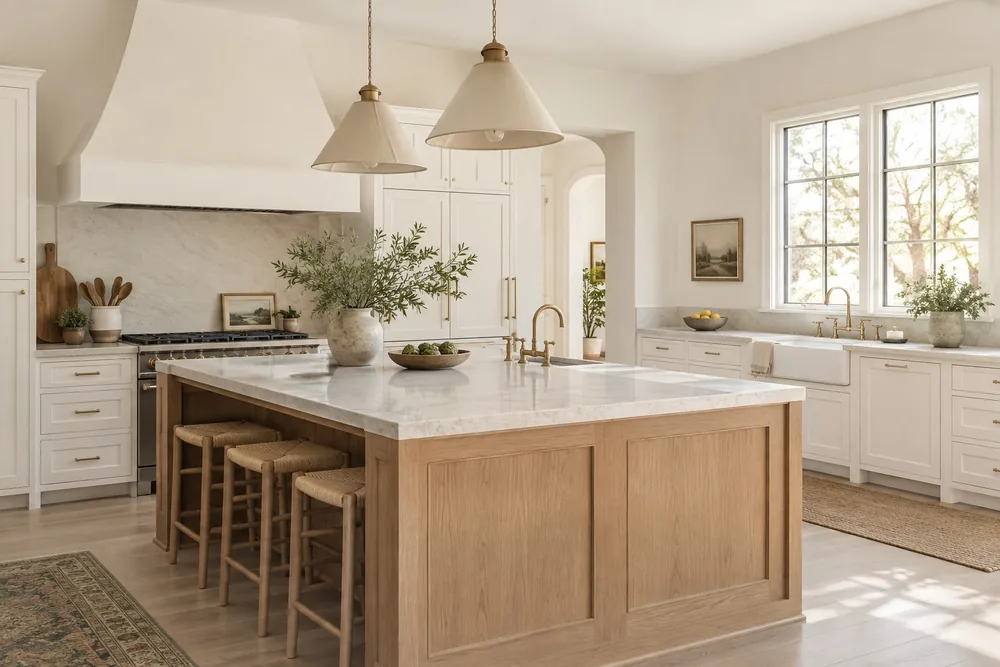
Begin with the weaker light
Marshmallow can be assessed for a north-facing room, but the direction alone cannot determine the result. Its LRV is 82; the key concern is a soft white with a pink edge beside stone . Marshmallow's pink undertone gives the white a specific relationship to investigate beside pink-beige stone.
Why the pink-beige marble and oak relationship matters
Marble veining can be flattering while the slab background disagrees, so the entire stone sample should remain visible.
Marshmallow has an LRV of 82; Sherwin-Williams Ivory Lace SW-7013 is 79. The difference is 3 points, with Marshmallow returning more light under the reference measurement.
Keep the surroundings in the test
Begin where Marshmallow meets the permanent white fixture on the least illuminated wall. A pale paint still requires light, and a high LRV cannot make that fixture relationship disappear. Check the daytime boundary and repeat under the lamps that carry the room after sunset.
A lighting result needs a practical decision
Use the marble's plain background as well as its veining in the test; pink should connect rather than dominate. The situations that call for another color covers that related choice.
Window size, obstruction and season still matter when choosing Marshmallow. A compass direction is not a brightness measurement. In the Northern Hemisphere, north-facing daylight is often less directly sunlit; the actual room remains the test. The daylight and evening-light checks covers that related choice. Before ordering samples, compare room-planning features in the paint color visualizer roundup.
Sources & notes
Color specifications: Sherwin-Williams Marshmallow SW-7001. The recorded LRV is 82. Named comparison values come from the respective manufacturers; material schemes are editorial suggestions.
This guide reviews published color information and proposes practical sample checks. It does not claim first-hand paint testing or customer-review scores. Sherwin-Williams does not sponsor or endorse this site. Product names and trademarks belong to their respective owners. Confirm the color in a physical sample and select the coating for the actual surface and finish.